PU vs PVC Conveyor Belts: Which Should You Choose?
Updated 6 October 2026 · ConveyPro Systems engineering team
In short: Choose PVC for dry, general-purpose conveying where cost matters — parcels, cartons, components. Choose PU where the belt meets oils, fats, sharp edges or food, or where it must stay clean and odourless. For wet, high-hygiene food zones, consider a homogenous TPU belt instead of either.
What PU and PVC belts have in common
Most light conveyor belts are built the same way: one or more plies of polyester fabric give the belt its strength and low stretch, and a thermoplastic cover on top (and sometimes underneath) does the work of carrying the product. The cover material is what the names PU and PVC refer to.
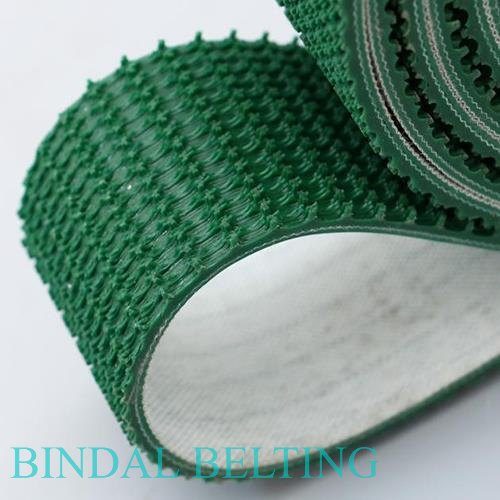
Both types are made endless the same way — usually with a hot-pressed finger joint, or with mechanical fasteners where the belt must go on without dismantling the conveyor — and both are available with smooth, matt, grip and rough-top surfaces, plus welded cleats, sidewalls and tracking guides. So the choice is not about construction; it is about how the cover material behaves in your application.
Side-by-side comparison
Property
PU (polyurethane) cover
PVC cover
Oil and fat resistance
Excellent — the right choice for oily parts and fatty foods
Fair — oils and fats can draw plasticiser out, hardening and cracking the cover over time
Cut and abrasion resistance
Very good; tough, thin covers last well
Good for general use; wears faster under sharp or abrasive products
Food contact
Widely used for direct food contact (FDA / EU 1935/2004 grades); odourless
Food-grade grades exist, best for dry, non-fatty foods
Weight and flexibility
Thinner, lighter belts for the same strength; suits small pulleys and knife-edge transfers
Usually thicker for the same duty
Range of special grades
Food, oil-resistant, high-grip, low-noise
Very wide: anti-static, flame-retardant, many surface patterns
Cleaning
Easy to clean; resists most cleaning agents
Easy to clean for dry products
Price
Higher
Lower — the economical workhorse
When PVC is the right choice
PVC belts are the economical default for dry products: parcels and cartons in logistics and e-commerce, components and assemblies in manufacturing, recycling lines, packaging end-of-line conveyors and airport baggage. If the product is dry, not oily and not sharp, a PVC belt does the job for less money.
Parcel, carton and bag conveying, including inclines with a rough-top cover
Assembly lines and general manufacturing
Applications needing anti-static or flame-retardant properties
Dry-food packing where the product does not contain oils or fats
When PU is worth the extra cost
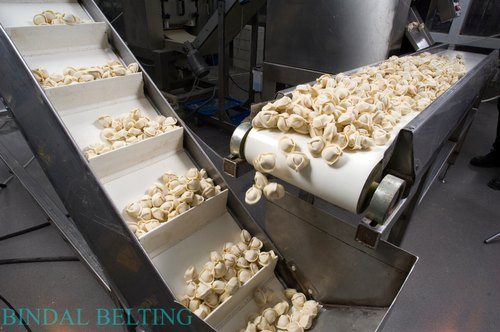
PU covers earn their higher price wherever the belt meets oils, fats, sharp products or food. In bakeries, confectionery, snacks and meat processing, a PVC belt can absorb fats and lose plasticiser, becoming hard, cracked and difficult to clean — a PU belt avoids that and stays odourless. In machining and automotive lines, PU resists coolants and cutting oils. And because PU belts can be thinner for the same strength, they run over smaller pulleys and tighter transfers.
Bakery, confectionery, snacks, meat, poultry and dairy processing
Oily or machined parts, coolant-wet conveyors
Sharp or abrasive products that would score a PVC cover
Small-pulley and knife-edge transfers in packaging machines
A third option for wet, hygiene-critical areas
Both PU and PVC belts have a fabric carcass. In very wet, frequently washed zones — meat, poultry, fish and dairy — liquids can wick into fabric edges or cut damage. A homogenous TPU belt is one solid material with no fabric at all, so there is nothing to absorb liquids or fray. It costs more again, but it is often the best choice where hygiene and wash-downs dominate.
What to tell your supplier
To recommend the right belt quickly, a supplier needs: what is being conveyed (and whether it is oily, fatty, wet, sharp or hot), belt length and width, the smallest pulley diameter, whether the belt runs on a slider bed or rollers, any incline, and the operating temperature.
Frequently asked questions
Not always. PU is better for oily, fatty, sharp or food products and for small pulleys; PVC is the better-value choice for dry, general-purpose conveying such as parcels, cartons and components.
Yes, food-grade PVC belts exist and are used for dry, non-fatty foods. For products with oils or fats, or for frequent wet cleaning, a food-grade PU or homogenous TPU belt is usually the better choice.
Oils, fats and some chemicals draw the plasticiser out of PVC, leaving the cover hard and brittle. Switching to a PU-covered belt normally solves this.
PVC belts cost less. PU belts cost more but usually last longer in oily, fatty or abrasive applications, which can make them cheaper over the belt's life.
World-leading homogenous thermoplastic elastomer belts — cut-resistant, easy to clean, ideal for hygiene-critical food and pharma applications. On-site butt jointing in just 3 minutes.