India's Trusted Conveyor Solutions Partner — 40+ Years of Expertise
+91-9323588809 | sales@conveypro.in

Novo Felt, anti-static and ESD belts plus precision timing belts for PCB assembly, inspection, test and component-handling lines.

Electronics lines are rarely heavy, but they are unforgiving. A static discharge can damage a board or component long before anyone sees it, a scratch can scrap a glass or polished part, and a belt that drifts by a millimetre can misfeed a placement head or a test fixture. We supply belts and drive parts for PCB assembly and inspection conveyors, component and sub-assembly handling, test and packing lines, and EV-battery module assembly: Novo Felt belts (soft and non-marking, with ESD-safe grades), anti-static/ESD belts, cleanroom ESD modular belts, BRECO/MULCO PU timing belts, and ConveyPro GT/HTD timing belts for precision axes and indexing drives.
Three questions decide the belt: must the surface dissipate static, must it be soft enough not to mark the part, and how accurately must it position the product? Tell us the surface-resistance range your ESD protocol asks for. Novo Felt is gentle but is not conductive by itself, so say if the line is ESD-controlled and we will confirm which felt grade can meet it. Where positioning matters we usually recommend timing or positive-drive belts, because a friction-driven flat belt can slip. A dissipative belt only drains charge if it is earthed, so we also ask about the frame and rollers; if a belt cannot do the job on its own, we will say so.

Soft, non-marking Novo Felt for scratch-sensitive parts; ESD-safe grades available.
Novo Felt belts: needled polyester felt for sheet-metal and glass handling, lamination, printing and delicate parts, with ESD-safe grades.
Details & enquiry →Dissipates static charge to protect boards and components.
Electrically conductive belts that safely dissipate static charge (surface resistance 10⁴–10⁹ Ω) — protecting sensitive electronics, batteries, and components during handling.
Details & enquiry →Static-dissipative, easy-to-clean modular belts for controlled areas.
Static-dissipative POM modular belts for cleanroom, electronics, and EV-battery handling where charge control and hygiene matter.
Details & enquiry →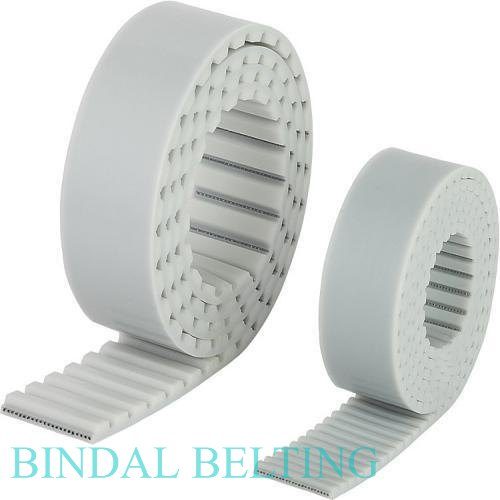
Accurate indexing and positioning on inspection and assembly axes.
German-made polyurethane timing belts with steel wire or Kevlar cord reinforcement. Available in T5, T10, T20, AT5, AT10, AT20, and HTD profiles.
Details & enquiry →
Compact curvilinear-tooth belts for small precision axes and automation drives.
Curvilinear-tooth GT (2, 3, 5 mm) and HTD (3M, 5M, 8M) timing belts for precision drives, CNC axes, robots and packaging machines.
Details & enquiry →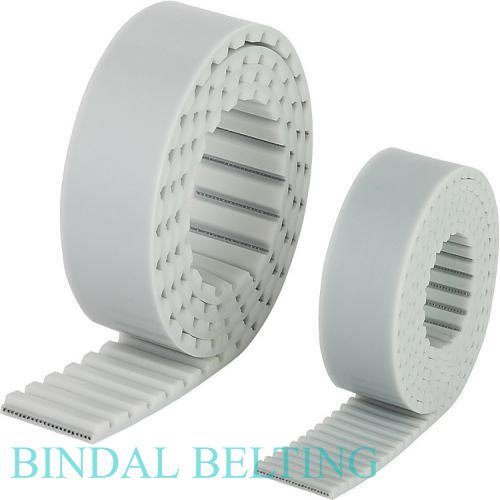
Cut-to-length belts for linear actuators and long-travel axes.
Cut-to-length polyurethane timing belts with steel or Kevlar cords for linear actuators and long-travel axes.
Details & enquiry →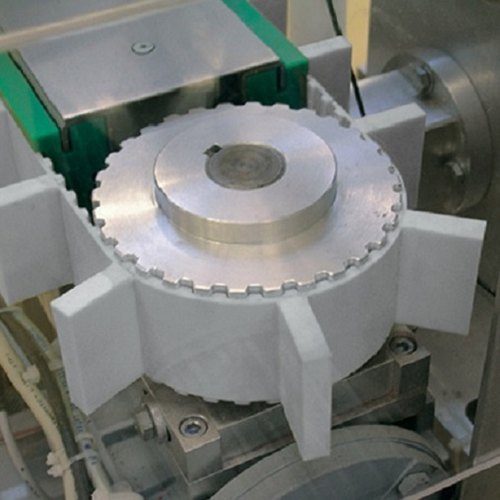
Cleats and pockets that carry and index parts at a fixed pitch.
Timing belts fitted with welded cleats, pushers, or profiles for indexing, positioning, and synchronised conveying.
Details & enquiry →
Positive-drive belt that does not slip, for accurate positioning.
Positive drive conveyor belts eliminating belt slippage — ideal for inclined conveying and precise positioning in food and pharma.
Details & enquiry →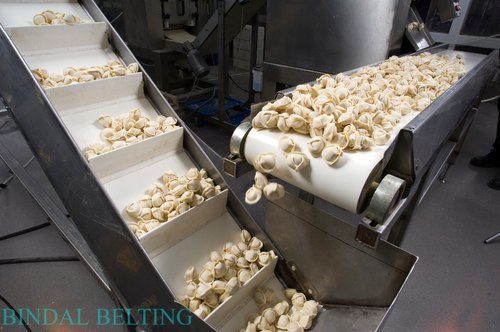
Anti-static grades available for general line conveying.
Versatile PVC conveyor belts suitable for general-purpose conveying across logistics, manufacturing, and recycling industries.
Details & enquiry →Compact drive for short transfer and inspection conveyors.
Sealed drum motors and motorised rollers — a compact, hygienic drive for belt and roller conveyors.
Details & enquiry →
Custom conveyors with variable-speed drives and PLC integration.
Custom-designed belt conveyor systems for material handling, product transfer, and process automation with PLC integration and variable speed drives.
Details & enquiry →Novo Felt belts are used where parts must not be scratched or marked, such as boards, glass and other delicate components on inspection, transfer and accumulation conveyors; the soft, low-friction surface also lets parts accumulate gently. Some of our Novo Felt grades are ESD-safe. Standard felt is not conductive by itself, so tell us whether your line is ESD-controlled and what resistance range you need, and we will confirm the grade.
Use the range your own ESD control protocol specifies, since it depends on what you are protecting. Our anti-static/ESD belts are static-dissipative, with surface resistance in the 10⁴–10⁹ Ω range. Tell us your target and how you measure it, and we will confirm the grade before you order.
No. A dissipative belt only drains charge if it has a path to earth, through earthing brushes or rollers and a grounded frame. Check the frame, rollers and bearings as well as the belt, and measure the installed conveyor rather than relying on the belt alone.
Timing (toothed) belts and positive-drive belts, because they cannot slip on the drive pulley the way a friction-driven flat belt can. Use a timing belt for indexing and axis drives, and a cleated or positive-drive belt where the product must be carried at a fixed pitch.
We list anti-static/ESD belts, cleanroom ESD modular belts, high-grip belts and timing belts for EV-battery handling. Tell us the module weight, the cell format and any ESD or cleanroom requirement, and we will recommend the combination.