India's Trusted Conveyor Solutions Partner — 40+ Years of Expertise
+91-9323588809 | sales@conveypro.in

European partner brand · Static Control Equipment
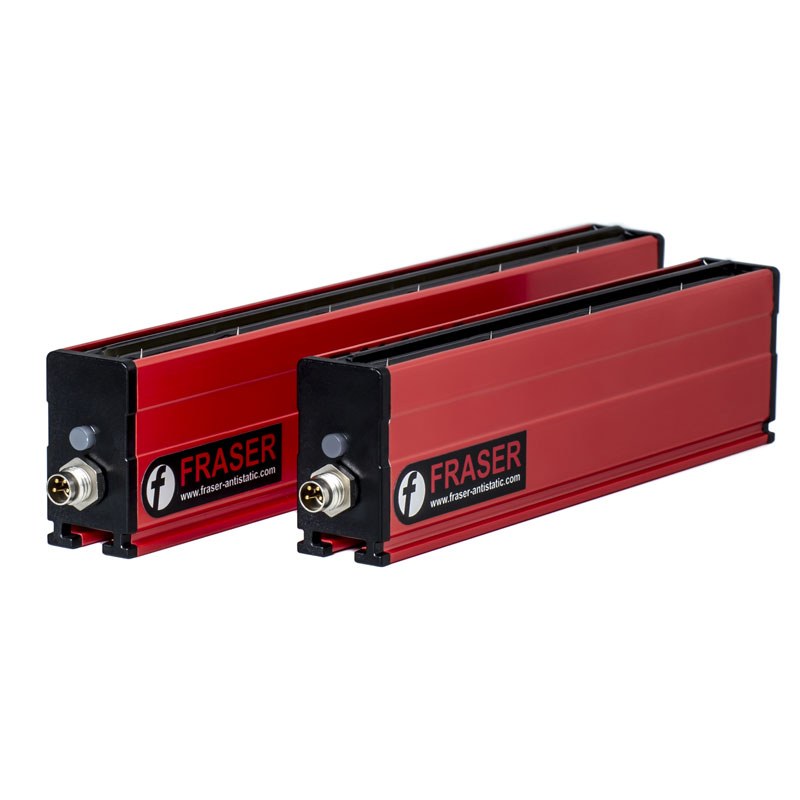
Compact ionising bars that neutralise static on film, labels and packs on moving lines, with built-in electronics on a 24 V DC supply.
Also known as: Static eliminator, Anti-static bar, Ionising bar, Static neutraliser, Static remover bar
A static eliminator bar is a row of fine emitter points that produce positive and negative air ions when powered. Pass a charged film, label or pack through that ion cloud and the charge is neutralised, so the material stops clinging to rollers, sheets stop sticking together, and dust stops being pulled onto the surface. These 24 V DC bars carry their electronics inside the housing, so they need only a low-voltage supply and signal cable, not a separate high-voltage power unit.
Static builds up whenever two insulating surfaces touch and separate: film peeling off a roll, a pack leaving a conveyor belt, a label lifting from its liner. Faster lines and drier air make it worse. The bar does not stop the charge being made; it removes it just after, so mount it where the charge causes trouble, just before the point of use.
It is the right answer for web, film, label and pack handling on packaging and conveying lines. It is the wrong answer for explosive or flammable atmospheres, for very wide winders or distances over about 1 m (long-range types are needed), and for belts that are themselves the source of the charge. For that last case, look at our Anti-Static / ESD Conveyor Belts.
| Short-range | Medium-range | |
|---|---|---|
| Typical distance to product | About 25 - 100 mm | About 100 - 500 mm |
| Typical use | Fast webs and films, close to the point of use | Where the bar cannot get close: guards, wide gaps, packs in motion |
| Line speed | Typically suits speeds above 1,000 m/min | Moderate speeds |
| Trade-off | Needs room right next to the material | Neutralises more slowly at the same distance |
Closer is almost always better: the nearer the emitters, the faster the charge is cleared. Choose the shortest range the machine layout allows. Typical figures only; the real working distance depends on the charge level, speed and material, so confirm for your line.
Older AC bars take a high-voltage feed from a separate power unit, and the cable between the two is part of the design. They are widely made and cheap, and can be the right call on a simple, short, non-critical run. DC bars keep the electronics in the bar and run on 24 V DC, which makes wiring simpler and safer to handle, allows a status output to the PLC, and suits compact machines. That is why machine builders often fit them as standard.
We quote the DC range. If you only need to neutralise occasional light charge on a slow, short line, a passive anti-static brush may be enough and costs less.
Do not judge a bar by the status light alone. Read the charge on the material before and after the bar with a handheld static field meter (see Handheld Static Field Meters). A working bar brings the reading close to zero; if it does not, the usual causes are a bar that is too far away, dirty emitters, or a second source of charge downstream of the bar.
Emitters slowly collect dust and residues from the air and from film, and a dirty emitter neutralises less. The bar flags this with its clean-me alert. Switch the bar off, clean the emitters with a soft brush and a little isopropyl alcohol, and let them dry before switching on. Emitters are replaceable, so a worn set is a part, not a new bar.
| Symptom | Likely cause | What to do |
|---|---|---|
| Film still clings or dust still collects | Bar too far from the material | Move it closer or change to a shorter-range type |
| Worked before, weaker now | Dirty or worn emitters | Clean them; replace if worn |
| Fine at low speed, weak at full speed | Not enough range for the line speed | Add a second bar or choose a type made for the speed |
| Charge returns after the bar | Another source of charge downstream (rollers, belt, guide) | Fit a second bar at the new problem point, or fix the source |
| Status or clean-me alert on | Contaminated emitters | Clean, then check with the meter |
The more of these you can give us, the faster the quote and the less likely we are to suggest the wrong type.
| Brand | European partner brand |
|---|---|
| Supply | 24 V DC; the electronics are inside the bar, so no separate high-voltage power unit |
| Working Distance | Short-range types typically about 25 - 100 mm from the product; medium-range types typically about 100 - 500 mm |
| Line Speed | Short-range types typically suit speeds above 1,000 m/min |
| Construction | Epoxy-resin-filled housing with replaceable tungsten emitters; compact profiles down to about 20 x 32 mm are available |
| Monitoring | Local status indication and a remote output to the machine PLC, including a clean-me alert |
| Length | Made to length for the application |
| Applications | Film and label unwinding and rewinding, Packaging and filling lines, Pre-print and pre-coat web cleaning, Plastic containers on conveyors, Pharma and food packaging lines (non-hazardous areas) |
It makes positive and negative air ions from fine emitter points. When charged film, labels or packs pass through them, the ions cancel the charge. The result is material that no longer clings, jumps, attracts dust or gives a shock.
No. The electronics are built into the bar, so it needs a 24 V DC supply and a signal cable. Older AC bars use a separate high-voltage unit.
Typically about 25 - 100 mm for short-range types and about 100 - 500 mm for medium-range types. Closer is better, so choose the shortest range your machine layout allows.
Short-range types typically suit line speeds above 1,000 m/min. Tell us your speed and web width and we will confirm the type.
Yes. The bar has a local status indication and a remote output to the machine control, including a clean-me alert, so the PLC can warn the operator.
Measure the charge on the material before and after the bar with a static field meter. A working bar brings the reading close to zero. The status light alone does not prove that.
It depends on the dust and film residue on your line, so there is no fixed interval. Use the clean-me alert, and switch the bar off before cleaning the emitters with a soft brush and a little isopropyl alcohol.
First move it closer. If that is not possible, use a second bar or a longer-range type. For very wide winders, or distances over about 1 m, a long-range type is the right answer.
No. These are standard bars and are not for flammable or explosive atmospheres. Equipment for those areas needs its own certification, which we do not offer on this page.
It will neutralise the charge, but if the belt itself keeps creating it, a belt that dissipates charge is the better fix. See our Anti-Static / ESD Conveyor Belts.
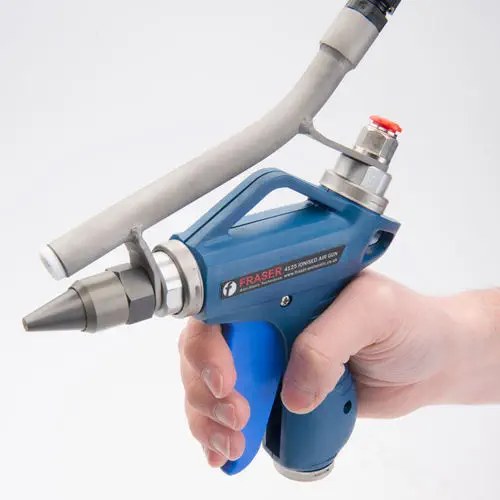
Compressed-air guns and nozzles that neutralise static and blow off the dust it attracts, for cleaning parts, sheets and packs before the next step.
Details & enquiry →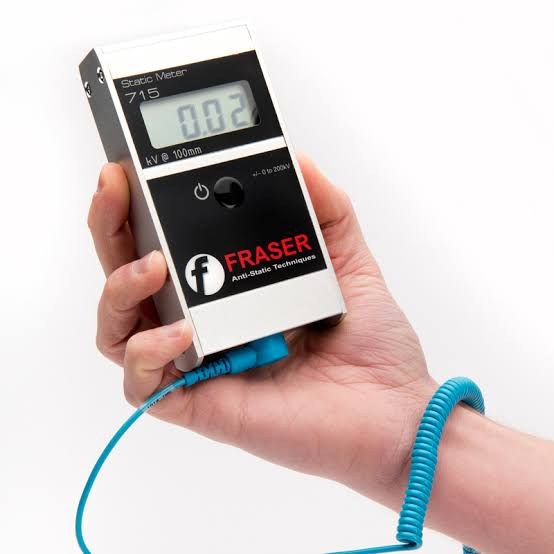
Handheld meters that read the static voltage on film, packs or machine parts, to find the problem and check that an eliminator is working.
Details & enquiry →