India's Trusted Conveyor Solutions Partner — 40+ Years of Expertise
+91-9323588809 | sales@conveypro.in

European partner brand · Static Control Equipment
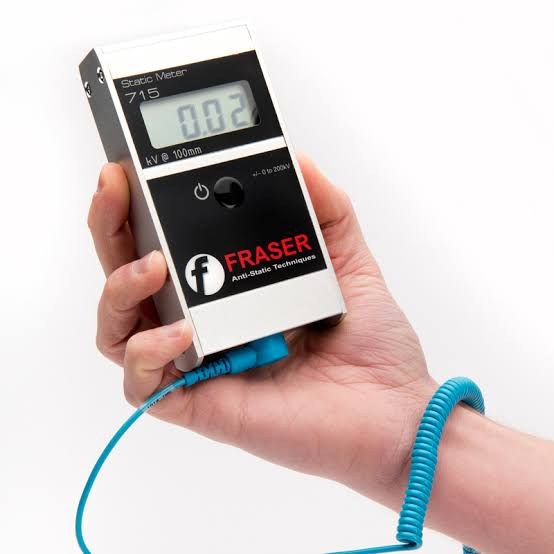
Handheld meters that read the static voltage on film, packs or machine parts, to find the problem and check that an eliminator is working.
Also known as: Electrostatic voltmeter, Static meter, Static field meter, Electrostatic field meter, Static tester
A static field meter reads the electric field from a charged surface, shown as a voltage, without touching it. Point it at film, a pack or a machine part and you see how much charge is there. Without a meter, static is guesswork: you see film clinging or dust collecting but not where the charge starts or whether a fix has worked.
Use it to find the point on the line where the charge is made, to check a static eliminator bar before and after it is fitted, and to audit lines now and then so a dirty or failing bar is caught early. That is why it is a low-cost first step before a bar.
It is not a certification instrument, and it does not tell you a safe limit for your process; that comes from your product, your customer or your own trials.
The number is the voltage on that surface at that distance. Use it to compare: where it jumps, that is where the charge is made; after a bar, a good reading is close to zero. We do not give pass or fail thresholds here, as they depend on your process and material. Ask your customer or product supplier what level is acceptable, or find it by trial.
| Job | What you do | What you learn |
|---|---|---|
| Find the source | Read along the line, before and after each roller or guide | Where the charge is made |
| Prove a bar works | Read before and after the bar | Whether it removes the charge |
| Audit a line | Read at set points each month | Drift as emitters get dirty |
| Compare materials | Read the same film from two suppliers | Which one charges more |
The more of these you can give us, the faster the quote and the less likely we are to suggest the wrong type.
| Brand | European partner brand |
|---|---|
| Measurement | Static voltage on a surface, read without touching it |
| Range | Typically up to about 200 kV, with automatic range switching |
| Use | Fault-finding, before-and-after checks on an eliminator, and periodic audits of a line |
| Applications | Finding where static builds up on a line, Proving a static eliminator is working, Checking film, label and web handling, Plastics and packaging maintenance |
The electric field from a charged surface, shown as a voltage, without touching it.
We advise it. It shows where the problem starts and proves the bar has fixed it. Without it you are relying on how the film looks.
Typically up to about 200 kV, with automatic range switching. Confirm for the version we quote.
The distance given in the meter's instructions. Keep it the same each time, because the reading changes with distance.
There is no single figure. It depends on the material and process. Ask your customer or product supplier, or set your own level by trial.
It reads the charge on the belt surface, which tells you if the belt is the source of charge. It does not measure the belt's surface resistance.
Yes. Dry air lets charge stay and build, so readings rise. Compare like with like.
No. It is a standard instrument and is not for flammable or explosive atmospheres.
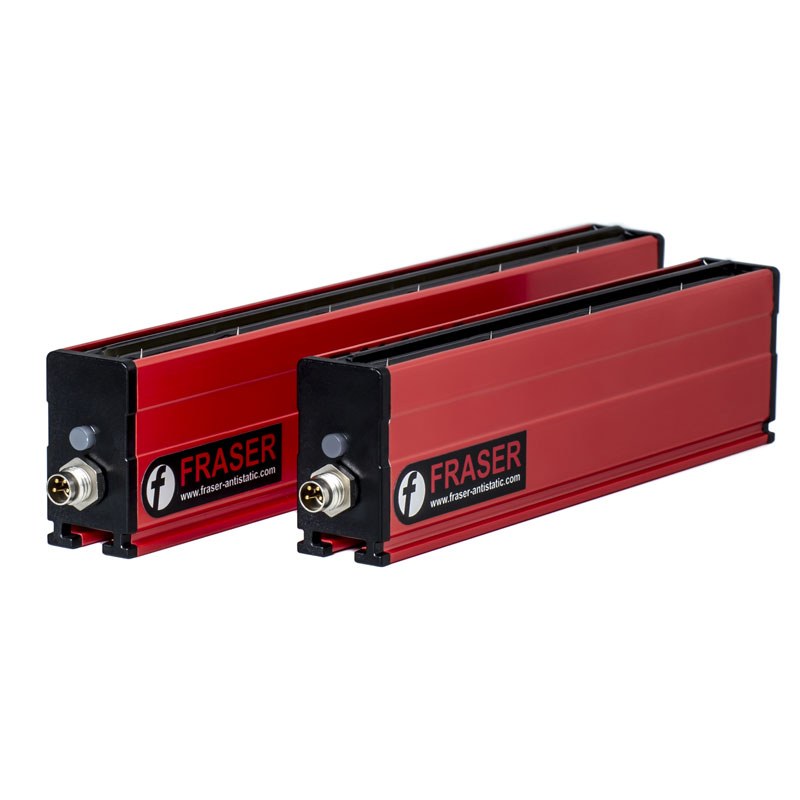
Compact ionising bars that neutralise static on film, labels and packs on moving lines, with built-in electronics on a 24 V DC supply.
Details & enquiry →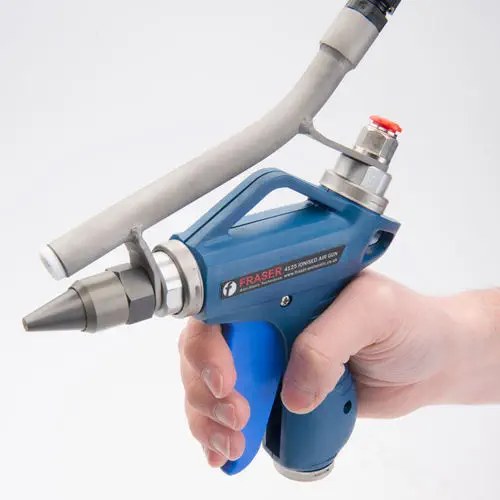
Compressed-air guns and nozzles that neutralise static and blow off the dust it attracts, for cleaning parts, sheets and packs before the next step.
Details & enquiry →