India's Trusted Conveyor Solutions Partner — 40+ Years of Expertise
+91-9323588809 | sales@conveypro.in

European partner brand · Static Control Equipment
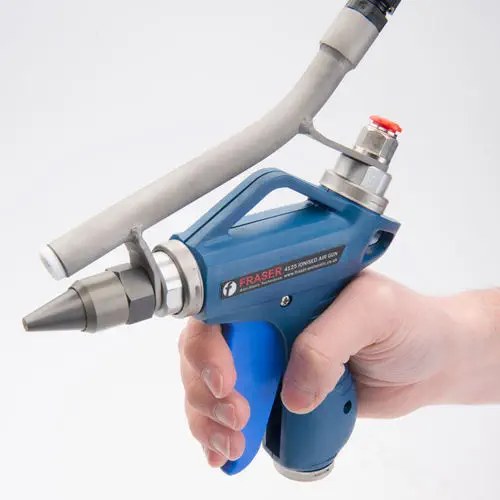
Compressed-air guns and nozzles that neutralise static and blow off the dust it attracts, for cleaning parts, sheets and packs before the next step.
Also known as: Ionising air gun, Anti-static air gun, Ionised air nozzle, Static dust removal gun, Ionising blow-off
An ionised air gun blows compressed air through an ionising electrode, so the air stream carries positive and negative ions as well as the push. On plastic, glass, film and painted surfaces, static holds dust tight, and plain compressed air often just moves it around or lets it settle again. Ionised air removes the charge as it blows, so the dust lets go and stays gone.
Handheld guns suit maintenance, rework and cleaning stations. Fixed nozzles are mounted on a machine to clean parts, sheets or containers in the line, before painting, printing, bonding, assembly or filling.
It is the wrong answer when the dust is not held by static (heavy chips, oily swarf), where a plain air jet or a vacuum is cheaper and does the job. It is also not for flammable or explosive atmospheres.
| Handheld gun | Fixed nozzle | |
|---|---|---|
| Best for | Maintenance, rework, cleaning stations | Repeat cleaning on a machine or line |
| Operator | Needed | Not needed; air can be switched by the machine |
| Typical output | About 5 N thrust at 5 bar | Set by nozzle type and supply |
| Versions | Air entry from the bottom or the top of the handle | Mounted at the point of use |
A surface that reads high on a static field meter before the gun and near zero after is cleaned properly. If it reads the same, check air pressure and the distance to the part. See Handheld Static Field Meters.
The more of these you can give us, the faster the quote and the less likely we are to suggest the wrong type.
| Brand | European partner brand |
|---|---|
| Air Supply | Clean, dry compressed air, typically about 5 bar |
| Output | Handheld guns typically give about 5 N of thrust at 5 bar |
| Versions | Handheld guns (air entry from the bottom or the top of the handle) and fixed nozzles for mounting on a machine |
| Applications | Cleaning parts before painting, Cleaning sheets before printing, Electronics and displays during assembly, Moulded plastic parts, Containers before filling |
Static holds dust onto plastic, glass and painted surfaces. Plain air moves the dust but leaves the charge, so it comes back. Ionised air removes the charge as it blows, so the dust lets go.
Typically about 5 bar of clean, dry compressed air. Measure at the gun, not the compressor.
Typically about 5 N of thrust at 5 bar. Treat it as a typical figure, not a promise for every version.
Handheld for maintenance and cleaning stations, where an operator decides what to clean. Fixed for repeat cleaning at a set point on a machine or line.
Yes. Water, oil and particles in the air end up on the part and can foul the ionising electrode. Fit a filter and dryer if your air is not clean.
Yes, that is a common use: sheets and parts are cleaned just before the painting or printing step, so dust does not show in the finish.
No. It removes dust and loose particles. Oil or grease needs cleaning with a solvent or wipe first.
When you need to capture the dust, not move it, or where blown dust would settle on other parts of the line.
No. These are standard items and are not for flammable or explosive atmospheres.
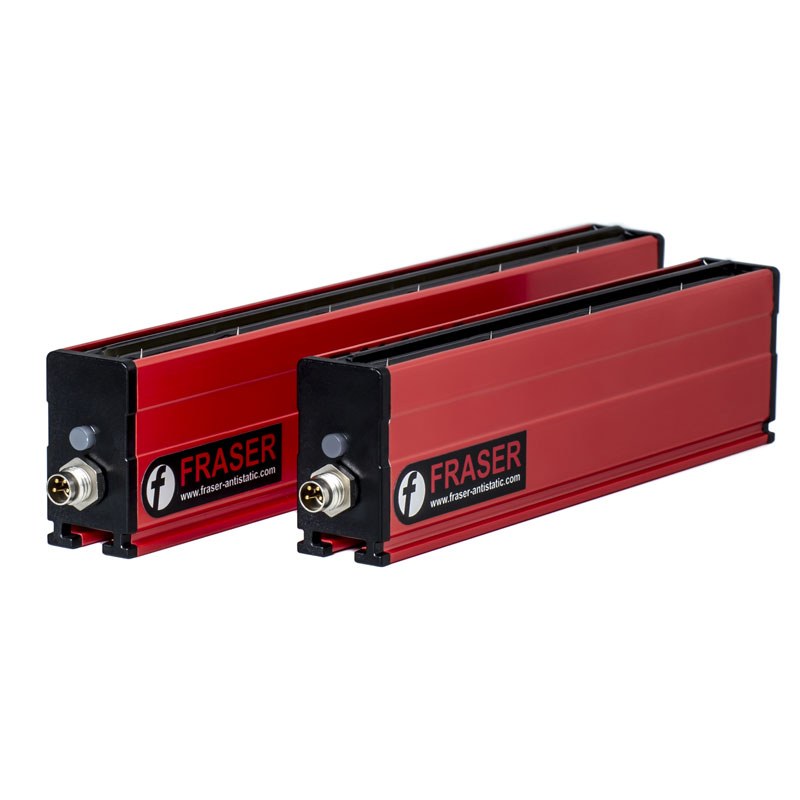
Compact ionising bars that neutralise static on film, labels and packs on moving lines, with built-in electronics on a 24 V DC supply.
Details & enquiry →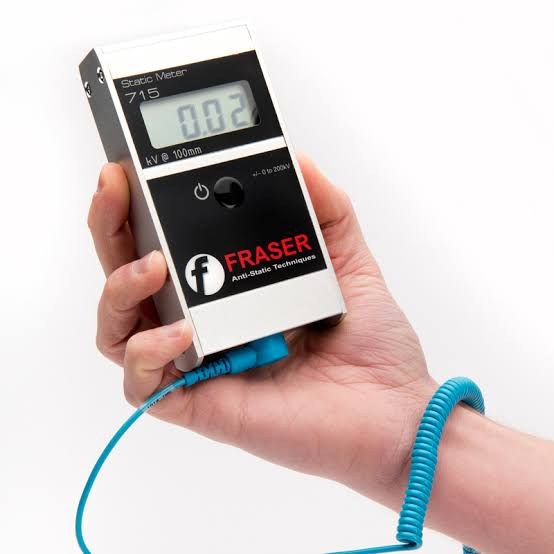
Handheld meters that read the static voltage on film, packs or machine parts, to find the problem and check that an eliminator is working.
Details & enquiry →